What Is Adenocarcinoma? Types, Causes, and Treatment

Well-Differentiated Thyroid Cancers
Content
If a thyroid nodule is suspected, your physician will review your medical and family history. The majority of patients diagnosed with papillary thyroid cancer have normal thyroid function. Patients with an overactive thyroid function ("hyperthyroid") usually do not have cancer. Those with underactive function ("hypothyroid") are slightly more likely to have cancer.
If thyroid cancer is suspected, the following diagnostic tests may be ordered:
Blood tests
Blood tests help show if your thyroid is functioning normally. Tests commonly ordered check levels of thyroid-stimulating hormone (TSH) and T3 and T4 hormones. Blood tests are also used to monitor thyroid cancers.
Biopsy
Fine-needle aspiration biopsy (FNAB) is the most useful test for determining if a thyroid mass is cancerous or not. This simple outpatient procedure involves a small needle injected into the mass or nodule. The needle removes cells that will be examined in the lab under a microscope. This test is sometimes unable to accurately diagnose thyroid cancer.
Imaging tests
Advanced imaging scans of your neck help your physician see the precise location and extent of the suspected cancer. Some of these include: Ultrasound scan (does not involve radiation), Computed tomography (CT) scan, and Magnetic resonance imaging (MRI).
Symptoms Of Papillary Thyroid Cancer
Symptoms of papillary thyroid cancer, which may not appear immediately, include swelling or pain in the front of your neck, difficulty swallowing, and a hoarse voice.
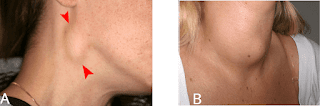
Papillary thyroid cancer rarely causes symptoms until it grows large enough to create a noticeable tumor. Most of the time, this tumor is easily treatable with surgery. If the tumor grows large, it might cause additional symptoms such as:
If papillary thyroid cancer is caught before it spreads to other tissues, the chances of dying from it in the United States are almost 0%.
Keep reading to learn more about the potential symptoms of papillary thyroid cancer.
Papillary thyroid cancer usually starts as a painless mass in your thyroid gland, sometimes with enlargement of surrounding lymph nodes. In roughly a quarter of people diagnosed, the cancer has spread to lymph nodes by the time of diagnosis.
The mass is usually less than 5 centimeters (about 2 inches) across. It usually feels firm and immobile when touched.
About 20% of people also have trouble swallowing or hoarseness when diagnosed. These symptoms are signs that the tumor is compressing the laryngeal nerve or your windpipe.
Papillary thyroid cancer is sometimes discovered before it causes symptoms during a routine physical exam or imaging for an unrelated problem.
Other potential symptoms include:
Metastatic thyroid cancerMetastatic cancer means that cancer has spread to distant parts of your body. Metastatic papillary thyroid cancer is rare, but when it occurs, it frequently involves your lungs or bones, such as your:
In a 2019 case study, researchers reported a rare case of papillary thyroid carcinoma spreading to the mandible, also called the jawbone.
Symptoms of metastatic papillary cancer that has spread to the bonesPotential symptoms of metastatic papillary cancer that has spread to bones include:
If the cancer spreads to your lungs, it's possible to develop symptoms such as:
Learn more about metastatic thyroid cancer.
Roughly two-thirds of people diagnosed between the years 2011–2020 in the United States had cancer contained to the thyroid gland, and only 2.1% had cancer spread to distant tissues. Papillary thyroid cancer often spreads to nearby lymph nodes, but cancer spread to lymph nodes usually still has a good outlook.
Of people diagnosed with papillary thyroid cancer from 2000–2019, 99.6% who hadn't died from unrelated causes were still alive 10 years after their diagnosis.
Here are the 5-year relative survival rates for papillary thyroid cancer in the United States between 2012–2018:
Factors linked to a poorer outlook include:
Learn more about the survival rate for thyroid cancer.
Papillary thyroid cancer is the most common type of thyroid cancer, and it also has the best outlook. The first symptom is often a noticeable mass in the front of your neck over your thyroid gland. Some people also have enlarged lymph nodes.
If you develop potential symptoms of thyroid cancer, it's important to seek medical attention as soon as possible.
With early treatment, almost everybody with papillary thyroid cancer limited to the thyroid gland survives. Surgery is the most common treatment for early-stage thyroid cancer.
What To Know About Thyroid Cancer Metastasis
Thyroid cancer is a type of cancer that begins in the thyroid gland. Cancer metastasis refers to cancer spreading to other parts of the body. How far it has spread can affect treatment.
The thyroid gland produces hormones that support metabolism, blood pressure, and other bodily functions. Thyroid cancer begins in this gland and can spread throughout the body.
Doctors use stages to describe how much cancer cells have metastasized. In earlier stages, thyroid cancer may spread to lymph nodes near the thyroid. In later stages, it may spread to organs and bones in distant regions of the body.
This article examines common sites of thyroid cancer metastasis. Keep reading to learn about where this cancer spreads, how to treat it, and more.
Thyroid cancer can spread to many different areas of the body, including:
In more advanced cases, thyroid cancer can spread to areas farther away from the thyroid, such as:
How far thyroid cancer spreads can affect treatment effectiveness. For example, cases that spread to the brain are some of the most difficult to treat.
Read more about thyroid cancer.
Signs that thyroid cancer has metastasized depend on where the cancer has spread. If cancer has metastasized to the bones, it can lead to:
If thyroid cancer spreads to the lungs, it may cause:
Thyroid cancer can also spread to other organs, such as the liver. Signs of this metastasis may include:
In many cases, people with thyroid cancer may not experience any signs that their cancer has metastasized, making regular check-ups a crucial part of cancer management. Only a medical professional can confirm whether thyroid cancer has spread.
Anyone experiencing symptoms of thyroid cancer should consult a doctor for a diagnostic evaluation. This will typically begin with a physical exam and medical history.
A doctor may also ask questions about a person's medical history. This helps determine whether someone is at higher risk for thyroid cancer.
If a doctor suspects the presence of thyroid cancer, they will then order imaging tests. These tests allow medical professionals to visualize internal areas of the body. Tests may include:
If an imaging test detects signs of cancer, the next step is a biopsy. This involves removing a small piece of tissue and sending it to a laboratory for analysis. At this point, a doctor may also order blood tests to check for other signs of cancer.
When the results of a biopsy test and scans confirm the presence of cancer, doctors can then determine the cancer's stage.
Stage 1 thyroid cancer is the least severe form of this disease. During this stage, cancer cells remain within the thyroid.
The most serious stage of thyroid cancer is stage 4. By this stage, cancer cells have spread to distant areas of the body.
Determining the cancer stage helps doctors identify the most effective treatment plan.
The right treatment for metastatic thyroid cancer depends on how far the cancer has spread. If cancer has not advanced beyond the thyroid, surgery to remove the cancer may be sufficient.
If cancer has metastasized to the lymph nodes, a surgeon can also remove the affected nodes. This may be enough to treat milder cases of metastatic thyroid cancer.
Doctors may opt for more intensive treatments in more advanced cases of this disease. Some of the more common treatment options for thyroid cancer include:
People whose cancer does not respond to conventional treatments may also choose to take part in clinical trials. This involves testing out new and emerging treatments before they are widely available to the public.
The chances of recovering from thyroid cancer increase if doctors diagnose this disease early.
People with localized thyroid cancer have the highest chance of making a full recovery. According to data, over 99.5% may survive for at least 5 years after diagnosis.
Cancer that has metastasized to distant parts of the body decreases a person's chance of recovery. People with distant thyroid cancer spread have between a 4% and 74% chance of surviving for at least 5 years.
However, factors such as a person's age, overall health, and type of thyroid cancer can affect individual outlook. It is also important to note that treatments continue to improve, and the statistics above use data from people diagnosed and treated at least 5 years earlier.
Thyroid cancer metastasis can look different for everyone. Identifying and treating metastatic thyroid cancer is also an individualized journey.
Where does thyroid cancer usually metastasize?Thyroid cancer often spreads to areas close to the thyroid gland. These may include neck muscles or blood vessels, the esophagus, or nearby lymph nodes. In more advanced cases, thyroid cancer may spread to the bones, liver, lungs, or brain.
What is the survival rate of metastatic thyroid cancer?The survival rate of metastatic thyroid cancer depends on the cancer stage. People who receive an early diagnosis typically have a 99.5% chance of recovering. For people in the more advanced stage, 5-year survival rates range from 4% to 74%.
At what stage does thyroid cancer spread?In stage 1 thyroid cancer, the tumor remains localized within the thyroid. From stage 2, cancer cells start to spread to nearby tissues. By stage 4, cancer has metastasized to distant regions of the body.
Thyroid cancer begins in the thyroid gland, which produces hormones that support various bodily functions. Without treatment, cancer cells may metastasize or spread to other body parts.
When thyroid cancer cells spread, they may affect lymph nodes, neck tissues, or the esophagus. In advanced cases, cancer can spread to the bones, liver, or other internal organs.
Treatment for thyroid cancer depends on how far cancer cells have metastasized throughout the body. People with early-stage thyroid cancer have the highest chance of responding to treatment.


Comments
Post a Comment